


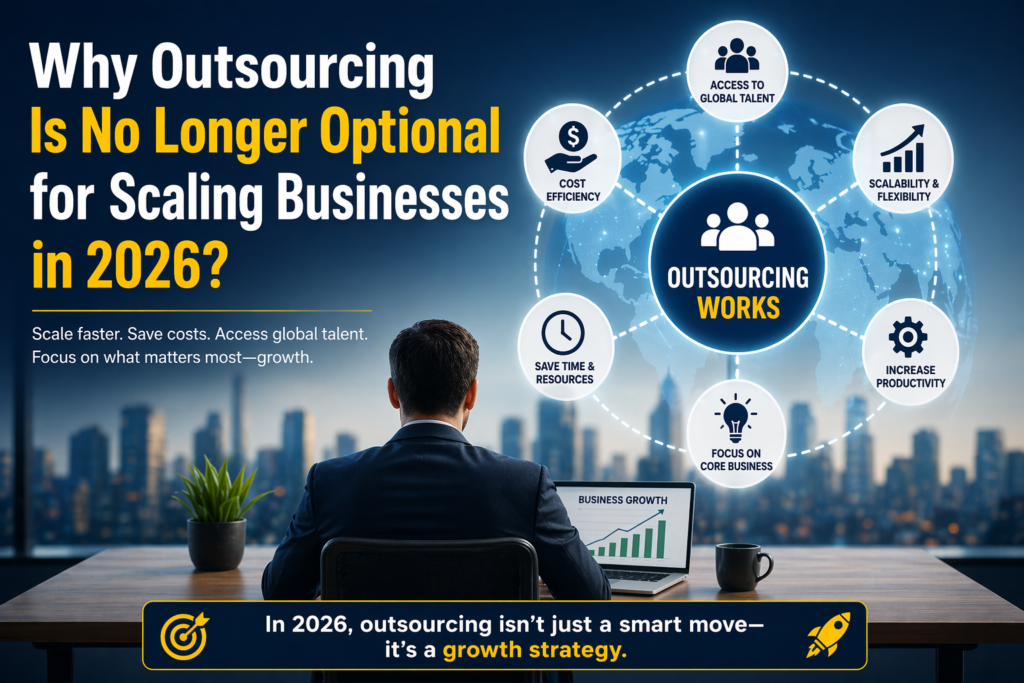
Imagine hiring a full-time executive assistant, a customer support specialist, a Shopify virtual assistant, and a payroll manager — all in the same week, without blowing your budget. A few years ago, that was a fantasy reserved for funded startups and Fortune 500s. In 2026, it’s Tuesday morning for the businesses that have embraced outsourcing.
Here’s the uncomfortable truth: while you’re doing everything yourself, your competitors are scaling with lean, outsourced teams that work around the clock. The global BPO industry is projected to exceed $620 billion by 2032, and the businesses fueling that growth aren’t the giant corporations you might expect — they’re agile startups, solo entrepreneurs, eCommerce brands, and digital agencies that figured out one critical thing: your time is your most valuable asset, and outsourcing protects it.
This isn’t about cutting corners. It’s about operating smarter in an era where doing it all in-house is the actual competitive disadvantage.
The Real Cost of Not Outsourcing in 2026
Most business owners calculate the cost of outsourcing. Very few calculate the cost of not outsourcing.
When you handle customer service, admin tasks, payroll, content, and operations manually — or hire full-time employees for every role — you’re absorbing:
- Recruitment and onboarding costs that can run 1.5–2x an employee’s annual salary
- Lost founder hours that should be spent on strategy, sales, and growth
- Operational bottlenecks that delay scaling by months
- Burnout — the silent killer of small business momentum
The advantages of outsourcing aren’t just financial. They’re structural. Outsourcing lets you build a business that runs efficiently without being entirely dependent on your personal bandwidth.
What Has Changed: Outsourcing in 2026 vs. 5 Years Ago
The BPO industry has undergone a fundamental transformation. This is not your grandfather’s call center model.
From Cost-Cutting to Strategic Scaling
Outsourcing used to be synonymous with reducing overhead. Today, the most forward-thinking businesses use it as a growth engine — bringing in specialized talent, AI-powered virtual assistant capabilities, and flexible team structures that adapt to business cycles.
The Rise of the AI-Powered Virtual Assistant
The modern virtual assistant service is no longer just calendar management and email sorting. In 2026, an AI-powered virtual assistant can handle:
- Lead generation and CRM updates
- Social media scheduling and engagement
- E-commerce order management (including Shopify virtual assistant tasks)
- Research, reporting, and data entry
- Inbox management for executive assistant-level support
This shift has made virtual assistant companies and agencies significantly more capable — and more indispensable — than ever before.
Virtual Assistant Services Are Now Industry-Specific
The market has matured to offer highly specialized roles. A virtual assistant for real estate, for instance, handles MLS listings, client follow-ups, and appointment scheduling. A real estate agent virtual assistant or virtual assistant for realtors understands the specific cadence of property transactions. IT virtual assistants manage helpdesk tickets, software updates, and vendor communications.
This level of specialization means you’re not just delegating tasks — you’re adding genuine expertise to your team.

Key Benefits of Outsourcing for Startups and Growing Businesses
Whether you’re a solopreneur or leading a 50-person agency, the advantages of outsourcing are measurable and immediate.
1. Dramatic Cost Reduction Without Quality Loss
Hiring a full-time in-house executive assistant in the US or UK can cost $50,000–$75,000 per year. A qualified executive virtual assistant through a reputable virtual assistant staffing agency can deliver the same — often more — for a fraction of that cost.
The benefits of offshoring extend beyond salaries: reduced office space, no benefits packages to manage, and zero recruitment overhead.
2. Access to a Global Talent Pool
Top-tier virtual assistant firms and virtual assistant recruitment agencies maintain vetted talent networks across multiple time zones. This means your business can operate 24/7 without paying overnight premiums.
3. Faster Scaling, Lower Risk
Need to double your customer support capacity during a product launch? With a virtual assistant agency, you scale up in days — not months. When the launch ends, you scale back down. No severance, no HR complications.
4. Outsource Payroll and Benefits — Eliminate Hidden Complexity
One of the most underrated advantages of outsourcing payroll is compliance. Payroll law changes constantly, and errors are costly. When you outsource payroll and benefits, you eliminate risk, reduce administrative burden, and free your internal team to focus on revenue-generating work. The benefits of outsourcing payroll alone are reason enough for many SMBs to make the switch.
5. Focus on Core Business Functions
A personal virtual assistant handles your scheduling, travel, and inbox. A business virtual assistant manages operations and vendor communication. This separation allows founders and CEOs to focus exclusively on decisions only they can make.

Outsourcing vs. In-House: A Practical Comparison
| Factor | In-House Team | Outsourced / Virtual Team |
|---|---|---|
| Setup Time | Weeks to months | Days |
| Monthly Cost | High (salary + benefits + overhead) | Flexible, task or retainer-based |
| Scalability | Slow, rigid | Fast, elastic |
| Specialized Skills | Limited by hiring market | Global access |
| Risk | High (turnover, compliance) | Low (managed by agency) |
| Management Load | Heavy | Minimal with the right partner |
The data is clear. For virtual assistant for small business owners, agencies, and eCommerce brands, the outsourced model consistently outperforms in both cost and agility.
Who Should Be Outsourcing Right Now?
If you fall into any of these categories, outsourcing isn’t a future consideration — it’s an immediate opportunity:
- eCommerce owners needing a Shopify virtual assistant for product listings, order tracking, and customer service
- Real estate professionals who need a virtual assistant for real estate — transaction coordination, listing management, and CRM upkeep
- Agency founders who need consistent content, outreach, and admin support without full-time hires
- Entrepreneurs and startup CEOs who need a virtual assistant for entrepreneurs to protect their time and mental bandwidth
- Small business owners who can’t justify full-time salaries but need consistent, skilled support
How to Choose the Right Virtual Assistant Service or BPO Partner
Not all virtual assistant companies are created equal. Here’s what to evaluate before committing:
Do:
- Ask about their vetting and training processes
- Request trial periods or starter virtual assistant packages
- Look for industry-specific experience relevant to your business
- Confirm communication protocols and time zone coverage
Don’t:
- Choose based on price alone — the cheapest option rarely delivers sustainable results
- Hire without a clear scope of work and KPIs
- Overlook cultural and communication compatibility
At 3S Solutions, for example, businesses get access to pre-vetted virtual assistants matched to their industry, workflow, and growth stage — with flexible engagement models that scale alongside them. The difference between a generic hire and a strategically matched outsourcing partner is the difference between treading water and actually moving forward.
New Long-Tail Keywords Driving Search in 2026
Businesses searching for outsourcing support today are using highly specific queries. If you’re building a content or SEO strategy around outsourcing, consider targeting:
- affordable virtual assistant service for eCommerce startups
- best virtual assistant packages for small business owners
- how to outsource payroll for a growing startup
- AI-powered virtual assistant for real estate agents
- executive virtual assistant for busy entrepreneurs
- virtual assistant staffing agency for digital agencies
These long-tail terms reflect how buyers are actually searching — with intent, specificity, and urgency.
The Bottom Line: Outsourcing Is Now a Baseline for Competitive Business
The question in 2026 is no longer “Should I outsource?” It’s “What’s still on my plate that shouldn’t be?”
The BPO industry has matured into a sophisticated, AI-augmented ecosystem of specialized talent, flexible virtual assistant services, and strategic partnerships that give lean businesses the operational power of companies three times their size. The advantages of outsourcing — cost efficiency, speed, scalability, and access to expertise — are no longer reserved for the enterprise level.
Every hour you spend on tasks that a skilled virtual assistant or outsourced team could handle is an hour not spent growing your business.
The businesses winning in 2026 aren’t necessarily the best-funded. They’re the most efficiently built.
Ready to Build a Smarter, Leaner Business?
If you’re serious about scaling without the overhead, 3S Solutions is ready to help you identify exactly where outsourcing can unlock the most value in your operations.
Whether you need an executive virtual assistant, a dedicated BPO team, or just a starting point, the conversation costs nothing — but the delay might.
Get in touch with 3S Solutions today and take the first step toward a more scalable business.
Published by 3S Solutions | Outsourcing • Virtual Assistants • Digital Operations
